I recently wrote about the very real physical climate risks facing the datacentres that power the diffusion of AI throughout the economy.
Investors are also vocal in their concerns about the very real resource intensity of these data centres in terms of their impact on the environment, grids and political power struggles.
But something important is missing from the debates I’ve seen and been involved in of late. I have rarely heard anyone clearly articulate the opposing question:
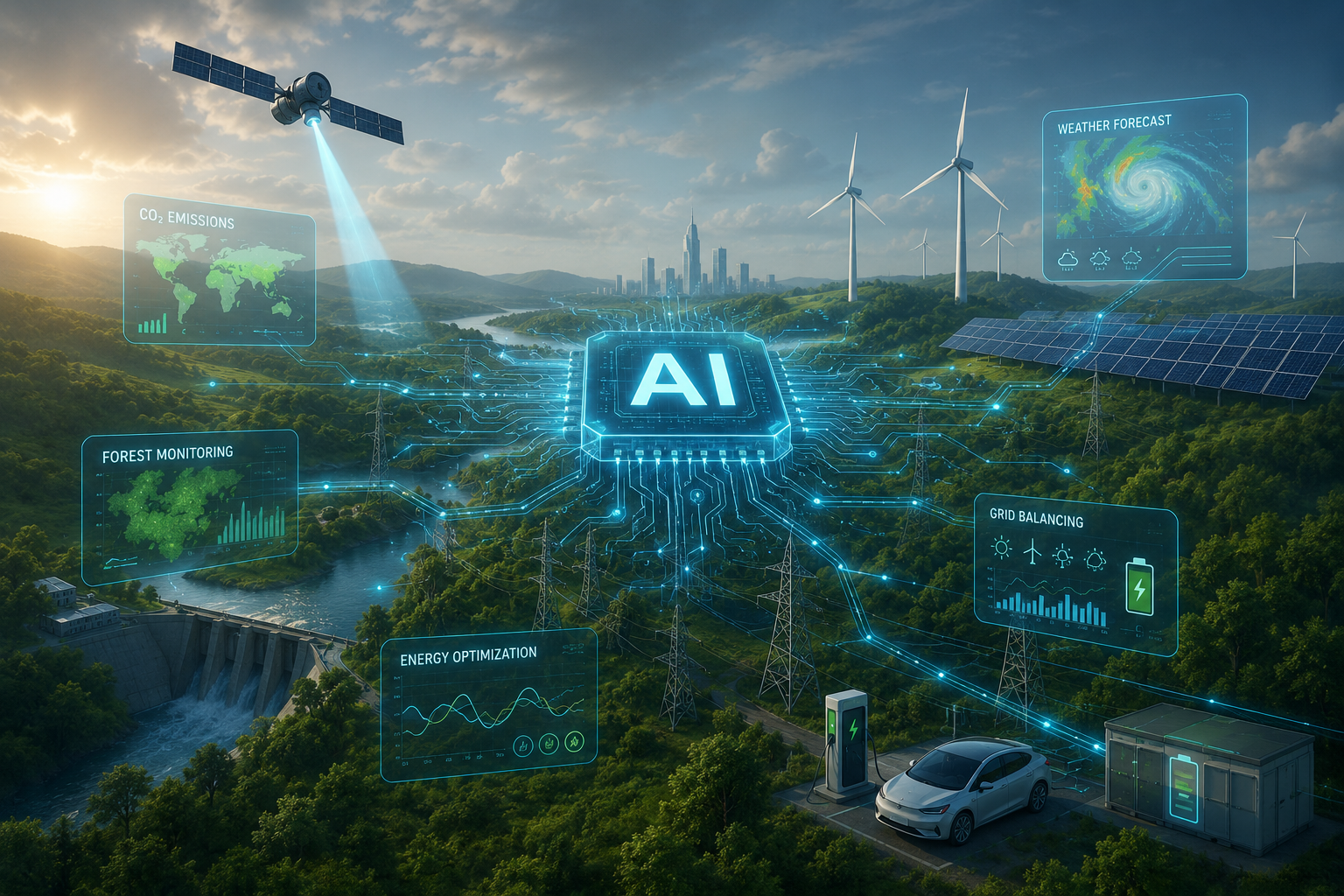
What if AI is the solution to our climate woes?
This doesn’t make the challenges of supporting AI diffusion in a resource-constrained, volatile physical world any less real in the short term.
But if AI is solving age old challenges in areas from mathematics and medicine, why are investors not as excited about its potential to mitigate climate change?
To understand the long-term outlook for the global economy and investment environment, we need to get to grips with how these two major themes interact. So far, most investor discussion has been focused on the negative effects of one on another.
It is time to look at the other side of the coin.
TLDR: AI’s vast capacity to search, read, analyse, model, and write can unlock some of the thorniest technological and bureaucratic roadblocks holding up the energy transition and innovate new decarbonisation solutions the human mind cannot. However, it cannot tackle the human short-termism driving policy weakness that drags on climate progress.
Why AI is well suited to meeting the climate challenge
It is not that investors don’t recognise that AI can play some role in the climate challenge. Bottom-up investors have been quick to highlight the investment opportunities in technologies like AI-assisted fertiliser sprays and ecosystem monitoring.
But I have recently been struck by the fact that when the top-down relationship between climate change and AI comes up in thematic discussions, we lack a positive framework for thinking about the interaction.
This runs the risk of repeating the mistakes of the sustainability wave a few years back: jumping to the highlight risk, focusing only on the challenge, hedging for the moral high ground.
Instead, it is worth reflecting on the strengths of AI and mapping those to the thorny challenges on the road to decarbonisation to see where this technology might just smooth the way.

1. Explore billions of possibilities
AI has extraordinary speed to sift through millions of options, speed that is needed to unlock technology roadblocks in decarbonisation.
Climate examples:
- Finding better batteries, solar cells, hydrogen catalysts, and low-carbon cement. Google’s GNoME project identified over 2 million potentially stable new materials; Microsoft screened 32 million candidates to find a new solid-state battery material in just a few days.
- Identifying and designing microbes that pull methane or carbon out of the air or soil.
- Working out the best designs for fusion and advanced nuclear reactors.
2. Spot patterns in messy data
AI is very good at finding meaningful signals in huge, noisy datasets — satellite images, sensor readings, time-series data — that humans can’t realistically process.
Climate applications:
- Detecting methane leaks and CO₂ sources from space, plant by plant. This is what makes emissions regulation enforceable and carbon markets credible.
- Tracking deforestation, soil degradation, and mangrove loss almost in real time.
- Mapping flood, fire, and heat risk to specific buildings, factories, and infrastructure.
- Predicting when grid equipment, wind turbines, or transformers will fail, so they can be fixed before they break.
3. Replace slow simulations with fast approximations
Lots of climate-relevant problems rely on simulations that take hours or days on supercomputers. AI can learn to mimic those simulations and run them in seconds on ordinary hardware, at similar accuracy.
Climate applications:
- Weather and climate forecasting. New AI models (GraphCast, Aurora, Pangu-Weather) run in minutes what used to take hours, making detailed local climate projections affordable for the first time.
- Wind farm layout, urban heat modelling, and building energy flow.
- Geothermal site assessment, carbon storage site evaluation, critical mineral exploration.
- Running thousands of “what if” scenarios on the power grid in real time, rather than as offline planning exercises.
4. Make real-time decisions in complex systems
AI can find good solutions in fast-moving, multi-variable systems — the kind of problems where there are too many moving parts for traditional methods to keep up.
Climate applications:
- Balancing the grid as more wind and solar come online – a huge operational obstacle to a low-carbon power system.
- Coordinating millions of home batteries, EVs, and heat pumps as if they were a single power plant (virtual power plants).
- Running heavy industry — steel, cement, chemicals, refineries — more efficiently. Even 1–3% efficiency gains in these sectors are large in absolute terms.
- Optimising freight routes, EV charging networks, and flight paths.
5. Read and write huge volumes of documents
AI can read, summarise, and draft text across millions of documents — something previously bottlenecked by human time.
Climate applications:
- Speeding up planning permission, environmental impact assessments, and grid connection queues.
- Turning unstructured corporate disclosures (TCFD, ISSB, CSRD filings) into comparable, searchable data.
- Synthesising scientific research so new findings reach industry faster.
- Speeding up due diligence on the many small renewable and energy efficiency projects needed at scale.
6. Write and improve software
AI can write, debug, and integrate software much faster than human teams can alone. This matters because almost every climate technology depends on software somewhere.
Climate applications:
- Climate tech startups are usually held back by engineering capacity. AI-assisted coding lets them ship products faster — grid software, emissions measurement platforms, energy management systems.
- Building “digital twins” of grids, factories, buildings, and cities at far lower cost than before.
- Writing the unglamorous firmware that runs inverters, smart meters, EV chargers and batteries — the software layer that hardware decarbonisation depends on.
- Modernising the decades-old IT systems utilities still run on, which unlocks the data needed for everything else.
The Limitations of AI tackling Climate Change
Clearly the opportunities for AI to vastly enhance our existing knowledge of climate harm and potential solutions are impressive. They should be an important part of the investor conversation and we should be updating our economic and market assumptions as these technologies advance and make headway in new discoveries.
However, while AI presents huge opportunities, it is not a complete solution to climate change.
I have written in the past about the fact that humans are the inspiration while AI is the technical implementation. An energy transition on the scale needed to limit climate change is a vast undertaking that requires political effort and popular support. In other words, humans need to be the inspiration.
The analysis in this article highlights that technology can certainly ease the path by reducing the costs of green solutions and identifying new ones.
But the immense challenge of setting a course for decarbonisation and then making it happen also relies on policy that creates incentives to change, which ultimately relies on people endorsing that change. Technology can reduce costs, which certainly helps on the economic incentives side of the ledger but wholesale transition requires both technology and policy.
AI cannot solve short electoral cycles that incentivises short-term reactive policymaking over long-term strategic direction setting. AI cannot solve deglobalisation and the retrenchment of major powers from partnership on climate to broad hostility.
In that light, it is striking that it is AI that presents opportunities to solve the climate crisis and it is people who are likely to hold it back.